Five Simple Spells to Trick Feeble Minds
Reader beware, for magic is in the air...

Before we begin, caution should prevail because some of these techniques do have a tangible effect on those around you. As with any spell, wish, or incantation, the outcome may be stronger than you could have possibly anticipated. Most importantly, you should not use any of these five techniques at all. Instead, only reflect on how they are used against you.
1. Summoning Someone Somewhere
The first one is simple. Imagine you want some person or group to come to an event that they may or may not have any interest in attending. We’ve all been there, whether it be it with our friends, for networking or when trying to initiate a date. In order to elevate their attendance from uncertain to plausible (if not downright assured), a particular role within the event must be called out. Of this event, state that “I will be doing this thing” or “there will be a known or relevant speaker/performer/exhibitionist doing that thing”.
At the end of the day, the fact any reason at all exists is enough for most people. And all this can be loaded into one word: because. At the same time, we can see also how easy it is for creative types or those with stage presences to get people behind them, regardless of the scope of the event. It’s not the place that matters but the role of the people in it. Suggesting involvement of the “guest” themselves in the event (such as inviting them to participate in activity rather than spectating) is riskier but also possible at this stage. All of this is basic stuff, but the next spell should be a little more interesting.
2. Splitting Reality in Twain
The second spell is also simple, but powerful. In order to rupture social reality, leverage the Mandela effect. You are aiming to trigger a mass misremembering. It becomes far easier when there is a larger scale of people, and less so with a few. Still, everyone has a false memory, and you can find, expose and conjure fake memories. Doing this, however, may result in the creation of two groups who are adamant about their perspective being the right one, to the point where evidence and facts become somewhat obsolete. This is the polarization part, often driven by ideological ambitions too.
You can also get people to confabulate details about things that don’t exist. Consider friends who have recounted a story about you multiple times you know not to be true. You have now created two separate realities (at least in the subjective sense of the term) that, given enough time and momentum, could become highly “defensible” by the groups clinging to the illusion.
Recently, the trend in modern politics, especially by the sinister clowns occupying the Trump circus and adjacent troupes, is to do just that. How many times have Musk, Trump and other Conservative political entities gaslighted us this year alone? Just scroll through X. You can see Trump sharing AI-generated content of Obama getting arrested, Trump as king taking a dump on protestors.
Dive deeper into the Mandela effect and more in a previous letter.

3. Beholding A Mystical Event
It is not necessary to be a cause of, or the subject of, a miracle. Only that the miracle is observed matters. There are many miracles that we can only verify secondhand. They nonetheless remain immune to contradictory evidence that suggests destiny is anything but a fundamental force. With rules we only barely understand.
Most science fiction movies were indirectly based on a movie that was never actually shot called Dune (based on the book by Frank Herbert). In 1976, the would-be director of the movie, O’Bannon, who would go on to write the screenplay for Alien. During their meeting, O’Bannon, who expected Jodorowsky to be a “raving lunatic” based on his films, was instead greeted by a “charming continental gentleman”. Jodorowsky went into his suitcase, pulled out a “little piece of folded up newspaper” which contained “special marijuana”.
O’Bannon recalled becoming “incredibly relaxed” after this, looking straight into Jodorowsky’s eyes. At the conclusion of a sentence, Jodorowsky’s face reportedly shot out “radiating lines of patterns” that formed a “circular shimmering mandala or kaleidoscope-like pattern” around his head, with his face in the center and eyes fixed on O’Bannon’s. The rest of the room seemed to vanish. This intense visual experience then relaxed, and Jodorowsky’s face returned to normal.
Following this experience, Jodorowsky asked O’Bannon to do the special effects, telling him to “sell everything you own and come to Paris and prepare to have your life changed”. O’Bannon accepted and subsequently moved to Paris to work on Dune, the movie that would never be.
Onto our second miracle. A young girl, with no military training, convinced crown prince Charles of Valois to allow her to lead a French army to lift a siege on a city. Joan of Arc reported that saints appeared to her in the form of voices. She was able to essentially convince the King of this too. Perhaps it can be explained away by simple intuition, making her life and influence far less mysterious. Her visions weren’t just auditory, however; they also involved vivid imagery. She could recall specific instructions and events and often make specific predictions of her opponents, despite being a young woman from a peasant family.
Finally, when a miracle can be directly acted upon, then true discovery becomes possible. Consider the role of dreams in shaping science. In one man’s dream, sledding at nearly light-speed caused the stars to glitter in unheard-of colors, a spectacle filled him with wonder. Einstein, only a teenager when he saw this, interpreted his dream as a signpost to a profound truth about light and motion. By bearing witness to a miracle, you gain some of its power to disrupt the psychic spheres that make up the inner worlds of our collective minds. To speak more bluntly, miracles give you a striking frame of reference to something that doesn’t even exist. Find and make your own miracles, report them, share them, and who knows, maybe you´ll even find one in your dreams.
4. Transmitting Signals Through Dreams
Too much (or any amount) of Burger King is a bad thing. However, I am actually the Sneak King (one of their most notorious mascots) himself.

Today I’m reporting a real ghost story. During Halloween, BK offered a ¼ lb of savory flame – grilled beef, a 100% white meat crispy chicken fillet, melted American cheese, thick cut bacon, creamy mayonnaise, and onions all assembled on a glazed green sesame seed bun. Researchers supposedly found this burger increased the incidence of nightmares with one participant reporting dreaming about a person turning into a burger and then a giant snake.
Burger King similarly launched a campaign in 2018 when the company teamed up with Florida Sleep & Neuro Diagnostic Services, Inc. Together, they produced the “Nightmare King’‘ burger for Halloween which included a “ghoulish green” bun and could be accompanied by a frozen black Fanta called, “Scary Black Cherry.” I tried some of their recent Halloween food, the Wednesday Adams themed burger, and it was pretty disgusting so maybe that’s why we are having bad dreams.
“According to previous studies, 4 percent of the population experiences nightmares in any given night,” said the study’s lead researcher and somnologist, Dr. Jose Gabriel Medina, in a statement. “But, after eating the Nightmare King, the data obtained from the study indicated that the incidence of nightmares increased by 3.5 times.”
BK are not the ones trying this approach to marketing. In 2021, a study by the American Marketing Association found that of 400 marketers surveyed, 77% planned to utilize dream-marketing techniques within three years. Robert Stickgold, a Harvard neuroscientist, has warned the public, “They are coming for your dreams, and most people don’t even know they can do it.”
The game “Sneak King”, sponsored by BK and offered as an exclusive game on the Xbox, may also appear in your nightmares too. In fact, Xbox partnered with researchers in sleep science to capture dreams from gamers after they used the Xbox Series X. The process involved inviting gamers into a semi-lucid (hypnagogic) state, recording dream content, and then translating that into visual / audio / creative media. In one of the campaign’s stories (“Lucid Odyssey,” directed by Taika Waititi), the dreams of one gamer (MoonLiteWolf) are dramatized — imagery from her dreamed worlds gets realized visually. They even employed Targeted Dream Incubation (TDI) — a technique to nudge dreams toward certain themes — as part of the campaign’s core creative “science.” Xbox claims this wasn’t just metaphorical: “Using the most advanced dream recording technology, dream scientists conducted lucid dreaming experiments … capturing and decoding the real dreams of gamers after they experienced Xbox Series X.”
Altering dreams is something that could take a lifetime of study without yielding fruit. But the ability of the human mind to take signs, associations and especially “uncanny” sights to the deepest recesses of our subconscious appears unlimited. In other words, what we say and show people does in some form end up in their dreams. The design needs to simply shift so that the artefacts you exposed to them in their waking life “catches them out.”. Something a little off can generate an uncanny feeling, or, appealing in a cute way can be highly memorable too.
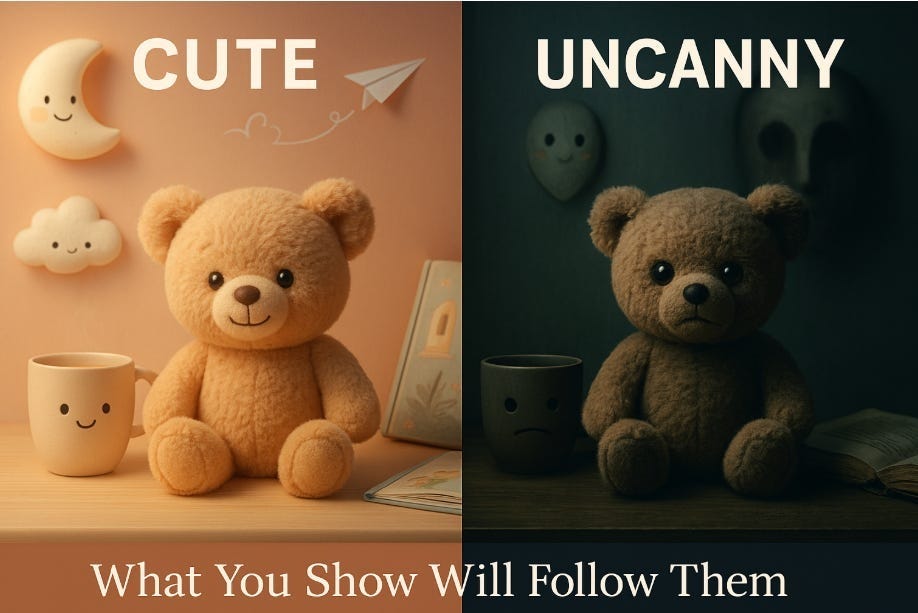
Remember, even one person with a dream incubated inside of them has the capacity to materialize and propagate this dream. This is the essence of the flow of creativity between a person and the external world. We are highly susceptible to these trickles into the subconscious, and in the waking world, we reshape the structure of society and its face. A more tangible takeaway is to use the principles of dream for non-dream settings (to make it easier).
By pumping signals with clear roots grounded in base human needs (the seven deadly sins, if you will), you increase the chances of it being embedded subliminally. Both sexual desire and oxytocin. regular intervals. and remember all learning is consolidated during sleep cycles too. This means the REM state is just a heightened version where they may interact with your brand more overtly, but it is always having an effect.
It’s time to use storytelling that mimics dream grammar — fragmentary narratives, unexpected associations, looping, and emotional displacement (e.g., Gucci’s surrealist ads, PlayStation’s “Mental Wealth” campaign). Add characters, use variations of known or accepted things, and integrate brands and artefacts into the backgrounds or layout of your products, adverts and social media. Let’s take a deeper look at one example using the final incantation.
5. Death by Love
We have reached our final spell, and the most dangerous, for we learn the easiest way to kill someone: through the guise of love. Essentially, you communicate and foster their need for something bad by presenting a good consequence of it.
It comes down to delivering a message through a medium that suggests a reality opposite to the instruction that is occurring. Take this image of Stalin. A warmonger and tyrant surrounded by loving, appreciative children tells your subconscious that the war is necessary to protect the children. It’s a tricky sleight of hand, but highly effective.
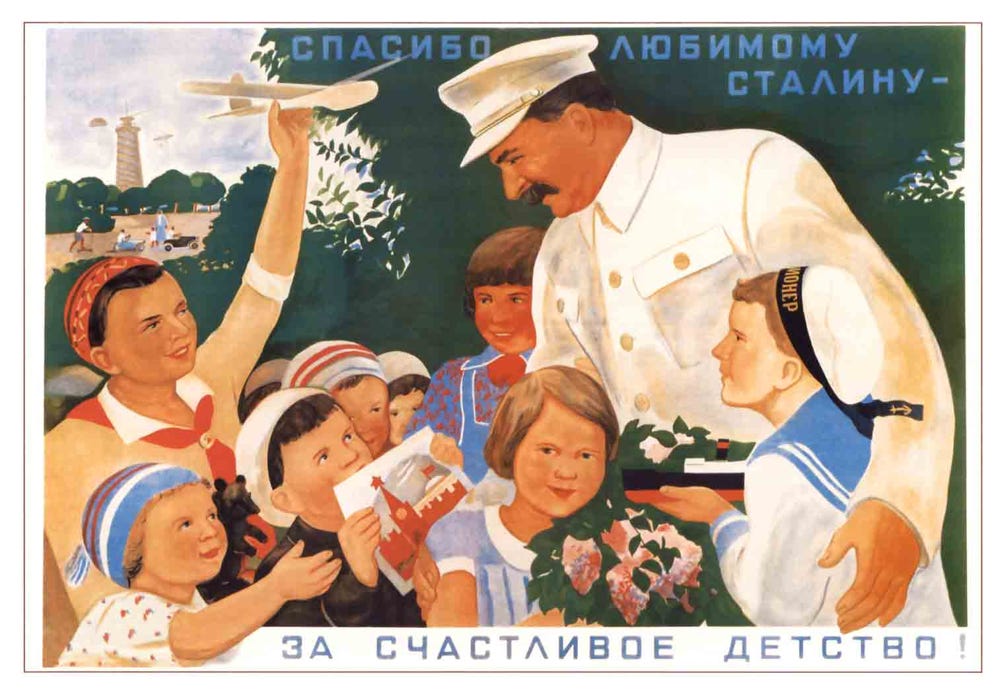
You present a message through a medium that contradicts it:
The contradiction creates cognitive dissonance (splitting reality in twin)
In trying to resolve the dissonance, people become malleable
You exploit that malleability to implant your actual message
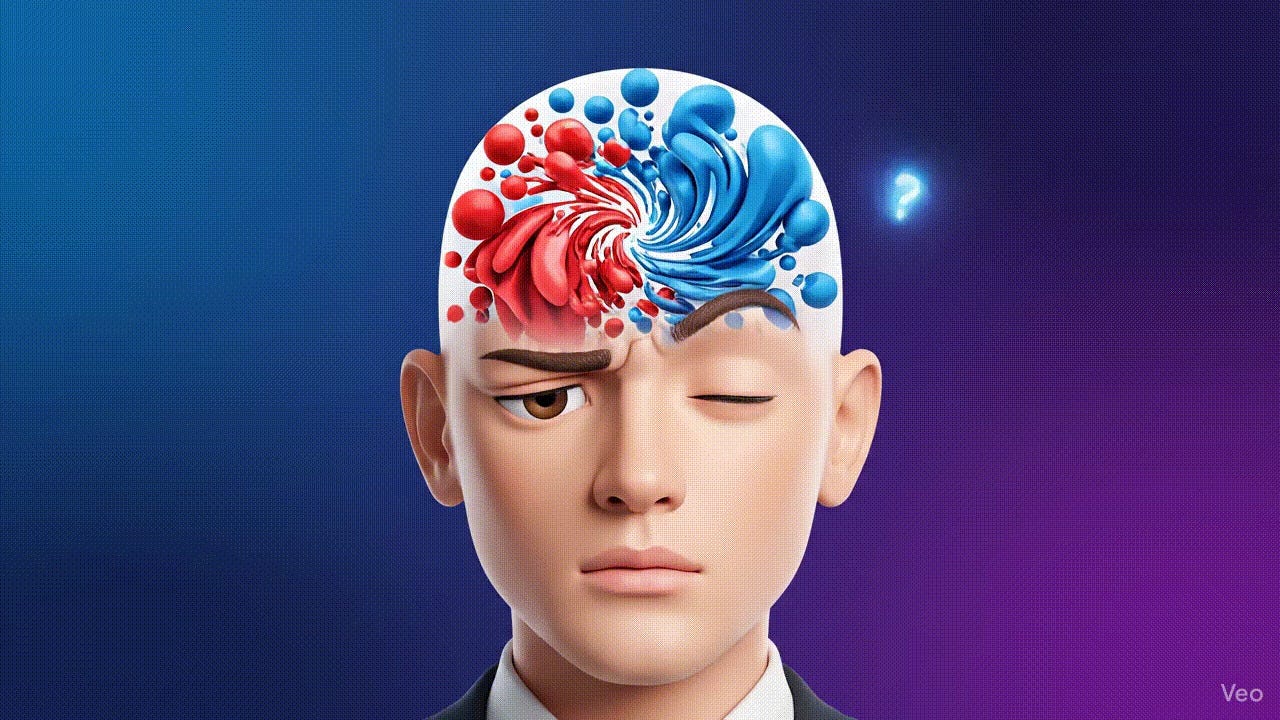
Then you can twist the knife further by using a medium invaded by its own opposite. Unfortunately, this technique has been used by ICE, the Trump-sponsored Anti-Immigration Militia, where their slogans in advertising (primarily to young white men) have included the likes of “defend your culture”. If I were helping Stalin for a new advert, I imagine the propaganda would align better to his evil intentions if it were to show children in the background bullying racial minorities, or otherwise mocking them through imitations or costumes. This would begin to mobilize the new generation rather than simply coddling them. Of course, you need a large enough following to avoid this backfire effect. Hehe.
Take how modern puppet shows these days are only lucrative in horror media (Five Nights at Freddy’s, Don’t Hug Me I’m Scared) but are derivative of the original non-horror puppet shows (Chuck-E-Cheese, Sesame Street). Interestingly enough, the creator of the Muppets made horror originally too.
You can leverage the previous spell, signals through dreams, in tandem with this spell. Know the masses: cater to Otakus, make cute mascots. Collectively and individually, the industry of video games (right now about 1.1% of the global digital economy). In particular, horror media, Roblox and Minecraft (both of which feature horror elements) are huge contributors to that figure.
Psychosis & Fairytales in the Digital Age

You step into the room for the final time. All of the objects that comprised your daily rituals, gone. The walls, stripped of their pictures and memories, stand bare, and the floor is silent except for the faint creaks beneath your feet. The room feels strangely different, almost as if it’s holding its breath.
In cycles of abusive relationships, it often goes something like this: partner commits violence, then buys flowers, writes apology letter, shows genuine affection. Afterwards, the victim thinks “He hurt me, but he loves me. The hurt must mean he loves me intensely.” The message (love) is contradicted by the medium (violence), which makes the love feel more urgent, more real, more worth preserving. Cult leaders, for instance, often use “flattery, affection and praise as bait” to recruit followers, only to later exploit or harm them – a parallel form of coercive control disguised as care. Typically, the leaders of the most destructive” cults (take Jim Jones, Applewhite of Heaven’s Gate cult, Manson, David Miscavige of Scientology) make a direct appeal or claim that their actions will lead to “survival” and even evoking a sense of divinity appeal or even “greater, ancient times”.
“I have seen by divine revelation the total annihilation of this country… The only survivors will be those people who are hidden in the cave that I have been shown in a vision… Those who go into this cave with me will be saved from the… radioactive fallout…” – Jim Jones.
“Planet Earth about to be recycled. Your only chance to survive—leave with us.” – Marshall Applewhite.
“You’re gonna change or else there’s going to be no life left on the planet Earth.” “I’m Jesus Christ whether you want to accept it or not…” – Charles Manson.
“…our real mission – the salvage of man and rehabilitation of his true spiritual nature.” – David Miscavige.

The mechanism is identical across all of them: begin with creating or inflaming existential fear, then position yourself as the sole solution, and finally invoke authority beyond question. Ever since I studied their use of language, I’ve been doing the same thing in my writings except my intentions are righteous, because I am showing you exactly what I am warning you about.
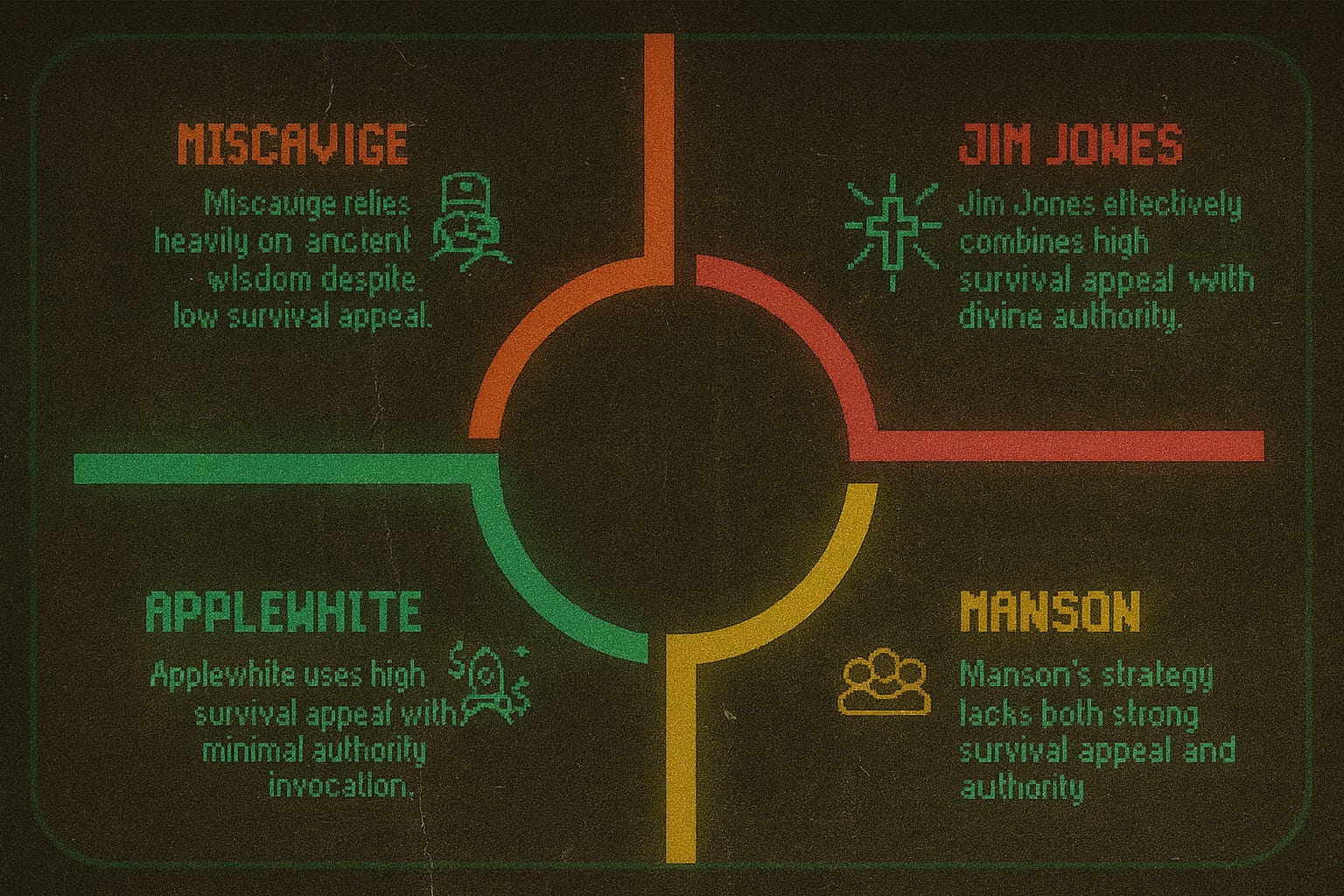
To boil this down, you can use visual, tactile, or auditory elements that stand contrary to your actual message, in order to make people more likely to follow your actual instruction. A cartoonish face can mask devilry while humour buries it under emotions. For the purposes of this explanation, let’s call it “reactance marketing”. This is loosely based on the idea of psychological reactance theory (Brehm, 1966). When people sense their freedom is being constrained (“you must believe this”), they resist, but when the message is subtly inverted—framed as caring, protective, or optional— they submit.
Slogans are dangerous for this reason. The word comes from the Scottish Gaelic sluagh-ghairm, meaning “battle cry” (sluagh = army, gairm = cry). It originally referred to the war cry of a clan. Beware the billion dollar corporations we’re all familiar with. To test the danger of a slogan, invert its meaning. Take these well known slogans and see how they put you into a bind, conveying that if you don’t buy this, you are somehow lesser in value. Think of Old Spice’s “Smell Like a Man, Man”, Reebok’s “Be More Human.”, Snickers’ “You’re Not You When You’re Hungry” and “Because You’re Worth It” from L’Oréal. They provide reassurance while simultaneously creating dependency. It creates fear while positioning itself as the solution. They present mixed signals that prevent rational decision-making. It obeys some of the language of cult leaders, too. “Without us, you’re vulnerable” (threat) + “We’ll protect you” (comfort).
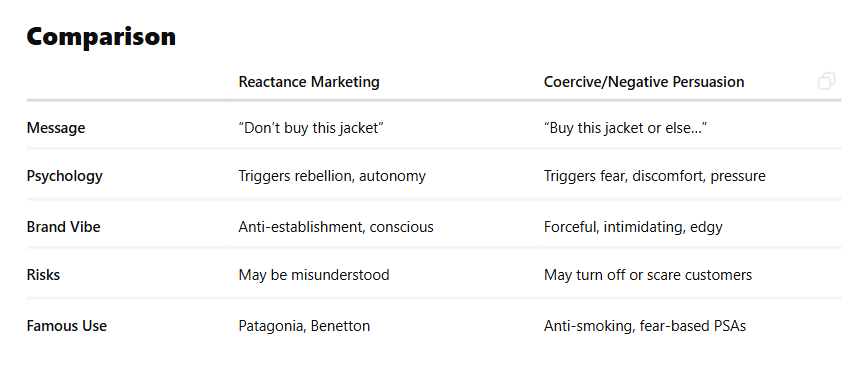
When it comes to negative persuasion, a simpler take-away in your daily life is just to remember that it’s often better to push people away rather than pull. Only if you know their intentions, even vaguely, should this be done. Because when you push, some people just draw closer. Then the effort lies not in getting what you want but in setting boundaries with others. This is the basic safety net we all want and deserve; and by casting this net wider, establishing a tone, delivering intent clearly and maintaining your values.
Besides pushing (or pushing back), striking a sensitive nerve with someone, without showing any fear or insecurity, has a comparable effect. At the same time, in this day and age most of us are so de-sensitized the impact of this probably won’t be as noticeable until dire examples occur. Hopefully, the need for such action never arises: being distant and hostile sucks. It is always worse to be the aggressor. Then defending your own headspace and indeed, managing the proximity of your social and physical life, should be seen as an act of peace. That is unless it violates the rights of another person.
Trauma bonding in marketing is a dark art of creating dependency through alternating fear and relief. The customer becomes psychologically attached to the very brand that “saves” them — the one that first unsettles and then comforts, that wounds and then heals. It’s not unlike the manipulative cycles of attachment found in abusive relationships, where the promise of safety becomes indistinguishable from the source of threat.
Cognitive dissonance exploitation works in tandem. Contradictory messages overwhelm rational thought, flooding the mind with confusion until the only way to resolve the discomfort is to accept the brand’s narrative. The consumer, desperate for coherence, aligns their beliefs with the company’s story — however distorted or self-serving it may be. Learned helplessness seals the bond. By emphasizing problems the customer can’t solve alone, marketers position their company as the only viable solution. The savior complex emerges — a familiar dynamic from cult psychology — where followers are made to believe that without the leader, or in this case the brand, they are powerless. And then there’s the showman effect: never actually show the substance of the product, only the spectacle surrounding it. These campaigns aren’t about soap or sneakers — they’re about identity, emotion, and belonging. “Trauma bonding” and “saviour complex” are how cult leaders do it. The same psychology, repackaged for capitalism.
Give your brand a specific voice, give it a face. Make it human enough to worship, but distant enough to be enjoyed. This is an inversion of an idol, where it would be non-human enough to be worshipped but intimate enough to be feared. That’s when a slogan becomes more than words — it becomes mythology. Then, make the brand voice have an underlying or suggestive aggression to the customer.
Consider how powerful this type of characterisation can become. Here’s a story too terrible to tell. In the 1980s, Domino’s created “The Noid” — a red, rabbit-eared villain whose whole purpose was to ruin your pizza experience. The slogan was “Avoid the Noid.” Seems harmless, right?
Wrong. On January 30, 1989, a man wielding a .357 magnum revolver stormed into a Domino’s in Atlanta, Georgia, taking two employees hostage. For five hours, he held a standoff with police, ordering his hostages to make him pizzas. The gunman’s name? Kenneth Lamar Noid. He shared the mascot’s name and became completely convinced that Domino’s was personally targeting him with their campaign. During the standoff, Kenneth Noid forced the employees to make him an “ExtravaganZZa” pizza — four kinds of meat, several vegetables, and extra mozzarella. Later, in his Florida apartment, Kenneth Noid died by suicide, still believing that Domino’s was targeting him.
A slogan, a story, a symbol — and a tragedy that reveals how marketing can reach far beyond persuasion, into the fragile territories of belief and identity. The simulacra invasion is upon us but driven by us. Many of us are turning workflows and products in businesses into animated, fully realized mascots with lore and multi-modal appearances.
We have reached our final spell, and the most dangerous, for we learn the easiest way to kill someone: through the guise of love. Essentially, you communicate and foster their need for something bad by presenting a good consequence of it.
It comes down to delivering a message through a medium that suggests a reality opposite to the instruction that is occurring. Take this image of Stalin. A warmonger and tyrant surrounded by loving, appreciative children tells your subconscious that the war is necessary to protect the children. It’s a tricky sleight of hand, but highly effective.
You present a message through a medium that contradicts it:
The contradiction creates cognitive dissonance (splitting reality in twin)
In trying to resolve the dissonance, people become malleable
You exploit that malleability to implant your actual message
Then you can twist the knife further by using a medium invaded by its own opposite. Unfortunately, this technique has been used by ICE, the Trump-sponsored Anti-Immigration Militia, where their slogans in advertising (primarily to young white men) have included the likes of “defend your culture”. If I were helping Stalin for a new advert, I imagine the propaganda would align better to his evil intentions if it were to show children in the background bullying racial minorities, or otherwise mocking them through imitations or costumes. This would begin to mobilize the new generation rather than simply coddling them. Of course, you need a large enough following to avoid this backfire effect. Hehe.
Take how modern puppet shows these days are only lucrative in horror media (Five Nights at Freddy’s, Don’t Hug Me I’m Scared) but are derivative of the original non-horror puppet shows (Chuck-E-Cheese, Sesame Street). Interestingly enough, the creator of the Muppets made horror originally too.
You can leverage the previous spell, signals through dreams, in tandem with this spell. Know the masses: cater to Otakus, make cute mascots. Collectively and individually, the industry of video games (right now about 1.1% of the global digital economy). In particular, horror media, Roblox and Minecraft (both of which feature horror elements) are huge contributors to that figure.
https://substack.com/home/post/p-147830890?utm_campaign=post
In cycles of abusive relationships, it often goes something like this: partner commits violence, then buys flowers, writes apology letter, shows genuine affection. Afterwards, the victim thinks “He hurt me, but he loves me. The hurt must mean he loves me intensely.” The message (love) is contradicted by the medium (violence), which makes the love feel more urgent, more real, more worth preserving. Cult leaders, for instance, often use “flattery, affection and praise as bait” to recruit followers, only to later exploit or harm them – a parallel form of coercive control disguised as care. Typically, the leaders of the most destructive” cults (take Jim Jones, Applewhite of Heaven’s Gate cult, Manson, David Miscavige of Scientology) make a direct appeal or claim that their actions will lead to “survival” and even evoking a sense of divinity appeal or even “greater, ancient times”.
“I have seen by divine revelation the total annihilation of this country… The only survivors will be those people who are hidden in the cave that I have been shown in a vision… Those who go into this cave with me will be saved from the… radioactive fallout…” – Jim Jones.
“Planet Earth about to be recycled. Your only chance to survive—leave with us.” – Marshall Applewhite.
“You’re gonna change or else there’s going to be no life left on the planet Earth.” “I’m Jesus Christ whether you want to accept it or not…” – Charles Manson.
“…our real mission – the salvage of man and rehabilitation of his true spiritual nature.” – David Miscavige.
The mechanism is identical across all of them: begin with creating or inflaming existential fear, then position yourself as the sole solution, and finally invoke authority beyond question. Ever since I studied their use of language, I’ve been doing the same thing in my writings except my intentions are righteous, because I am showing you exactly what I am warning you about.
To boil this down, you can use visual, tactile, or auditory elements that stand contrary to your actual message, in order to make people more likely to follow your actual instruction. A cartoonish face can mask devilry while humour buries it under emotions. For the purposes of this explanation, let’s call it “reactance marketing”. This is loosely based on the idea of psychological reactance theory (Brehm, 1966). When people sense their freedom is being constrained (“you must believe this”), they resist, but when the message is subtly inverted—framed as caring, protective, or optional— they submit.
Slogans are dangerous for this reason. The word comes from the Scottish Gaelic sluagh-ghairm, meaning “battle cry” (sluagh = army, gairm = cry). It originally referred to the war cry of a clan. Beware the billion dollar corporations we’re all familiar with. To test the danger of a slogan, invert its meaning. Take these well known slogans and see how they put you into a bind, conveying that if you don’t buy this, you are somehow lesser in value. Think of Old Spice’s “Smell Like a Man, Man”, Reebok’s “Be More Human.”, Snickers’ “You’re Not You When You’re Hungry” and “Because You’re Worth It” from L’Oréal. They provide reassurance while simultaneously creating dependency. It creates fear while positioning itself as the solution. They present mixed signals that prevent rational decision-making. It obeys some of the language of cult leaders, too. “Without us, you’re vulnerable” (threat) + “We’ll protect you” (comfort).
When it comes to negative persuasion, a simpler take-away in your daily life is just to remember that it’s often better to push people away rather than pull. Only if you know their intentions, even vaguely, should this be done. Because when you push, some people just draw closer. Then the effort lies not in getting what you want but in setting boundaries with others. This is the basic safety net we all want and deserve; and by casting this net wider, establishing a tone, delivering intent clearly and maintaining your values.
Besides pushing (or pushing back), striking a sensitive nerve with someone, without showing any fear or insecurity, has a comparable effect. At the same time, in this day and age most of us are so de-sensitized the impact of this probably won’t be as noticeable until dire examples occur. Hopefully, the need for such action never arises: being distant and hostile sucks. It is always worse to be the aggressor. Then defending your own headspace and indeed, managing the proximity of your social and physical life, should be seen as an act of peace. That is unless it violates the rights of another person.
Trauma bonding in marketing is a dark art of creating dependency through alternating fear and relief. The customer becomes psychologically attached to the very brand that “saves” them — the one that first unsettles and then comforts, that wounds and then heals. It’s not unlike the manipulative cycles of attachment found in abusive relationships, where the promise of safety becomes indistinguishable from the source of threat.
Cognitive dissonance exploitation works in tandem. Contradictory messages overwhelm rational thought, flooding the mind with confusion until the only way to resolve the discomfort is to accept the brand’s narrative. The consumer, desperate for coherence, aligns their beliefs with the company’s story — however distorted or self-serving it may be. Learned helplessness seals the bond. By emphasizing problems the customer can’t solve alone, marketers position their company as the only viable solution. The savior complex emerges — a familiar dynamic from cult psychology — where followers are made to believe that without the leader, or in this case the brand, they are powerless. And then there’s the showman effect: never actually show the substance of the product, only the spectacle surrounding it. These campaigns aren’t about soap or sneakers — they’re about identity, emotion, and belonging. “Trauma bonding” and “saviour complex” are how cult leaders do it. The same psychology, repackaged for capitalism.
Give your brand a specific voice, give it a face. Make it human enough to worship, but distant enough to be enjoyed. This is an inversion of an idol, where it would be non-human enough to be worshipped but intimate enough to be feared. That’s when a slogan becomes more than words — it becomes mythology. Then, make the brand voice have an underlying or suggestive aggression to the customer.
Consider how powerful this type of characterisation can become. Here’s a story too terrible to tell. In the 1980s, Domino’s created “The Noid” — a red, rabbit-eared villain whose whole purpose was to ruin your pizza experience. The slogan was “Avoid the Noid.” Seems harmless, right?
Wrong. On January 30, 1989, a man wielding a .357 magnum revolver stormed into a Domino’s in Atlanta, Georgia, taking two employees hostage. For five hours, he held a standoff with police, ordering his hostages to make him pizzas. The gunman’s name? Kenneth Lamar Noid. He shared the mascot’s name and became completely convinced that Domino’s was personally targeting him with their campaign. During the standoff, Kenneth Noid forced the employees to make him an “ExtravaganZZa” pizza — four kinds of meat, several vegetables, and extra mozzarella. Later, in his Florida apartment, Kenneth Noid died by suicide, still believing that Domino’s was targeting him.
A slogan, a story, a symbol — and a tragedy that reveals how marketing can reach far beyond persuasion, into the fragile territories of belief and identity. The simulacra invasion is upon us but driven by us. Many of us are turning workflows and products in businesses into animated, fully realized mascots with lore and multi-modal appearances.